Issue 03: Earth
Earth Dialogue
The meditation moves from beneath the Earth toward the surface and into the home:
seismic activity → soil → tree → insects → birds → food preparation → voice → rest
We begin with a sonification of seismic data from the September 27, 2014 eruption of Mount Ontake, Japan, a steam-driven eruption in which hydrothermal fluids moved upward through rock toward the surface. The meditation begins at the meeting place of the elements: water moving through rock, transformed through heat and pressure, and emerging through the Earth body.
From there, we move through a contact-microphone recording within a compost heap and upward into a willow tree. Listening through the contact mic, we hear the fluid nature of the Earth body: the internal activity of the tree, water moving from roots toward leaves through xylem, sugars moving through phloem throughout the living tree, and wind moving through its body.
The sound field opens outward into terrestrial life through crickets and cicadas, and then upward into birds.
From there, we enter the home: spinach being sorted, food sizzling, water boiling for ramen, and the metallic rhythm of two forks separating noodles. Earth, water and fire meet through the ordinary act of preparing food while the outside world remains present through the open window.
The meditation closes in the kitchen, singing with the crickets while cooking: voice, insects, food preparation and the surrounding environment sharing the same sonic field.
The underlying noise floor is composed from field recordings gathered while meditating with the Earth body through the seasonal cycle between the June solstice and the September equinox. The approach to listening, recording and composition draws inspiration from the work of Hildegard Westerkamp and Annea Lockwood, including ideas from Westerkamp’s Music, Sound and Conflict, and from practices of attentive environmental listening in which field recording becomes a form of relationship rather than simply the collection of environmental sound.
This episode moves from dialogue into embodied integration, poetry, and a listening meditation on the Earth body.
The integration practice begins with three minutes of alternate nostril breathing, followed by humming. A gentle laugh is gradually brought into the hum until it opens into ridiculous, full-bodied laughter. This sequence draws inspiration from teachings by Vickie Dodd and Laraaji, using breath, vibration, resonance and laughter to move energy through the body and prepare the field for deeper listening.
From there, we move into poetry from Ursula K. Le Guin’s Always Coming Home before entering a listening meditation on the Earth body.
Earth Meditation Notes
Credits
Abram Morphew — piano; sonification of seismic data from Mount Ontake, September 27, 2014; audio optimization and post-production.
Gina Wizostky — field recordings of crickets, cicadas, birds and sorting spinach; voice recording and web design in Durham, North Carolina.
Bethany Carder — field recordings of crickets, cooking, boiling water and metal utensils, seasonal Earth-body meditations and noise floor; voice, poetry and meditation introduction; editing and mixing; recording in Portland, Oregon.
Recorded by Gina Wisotzky and Bethany Carder on August 25, 2026 at 6:00 AM PDT / 9:00 AM EDT, in Portland, Oregon and Durham, North Carolina.
At the time of recording, Leo was rising in Portland and Virgo was rising in Durham, echoing the seasonal movement we were exploring from Leo toward Virgo and into the September equinox.
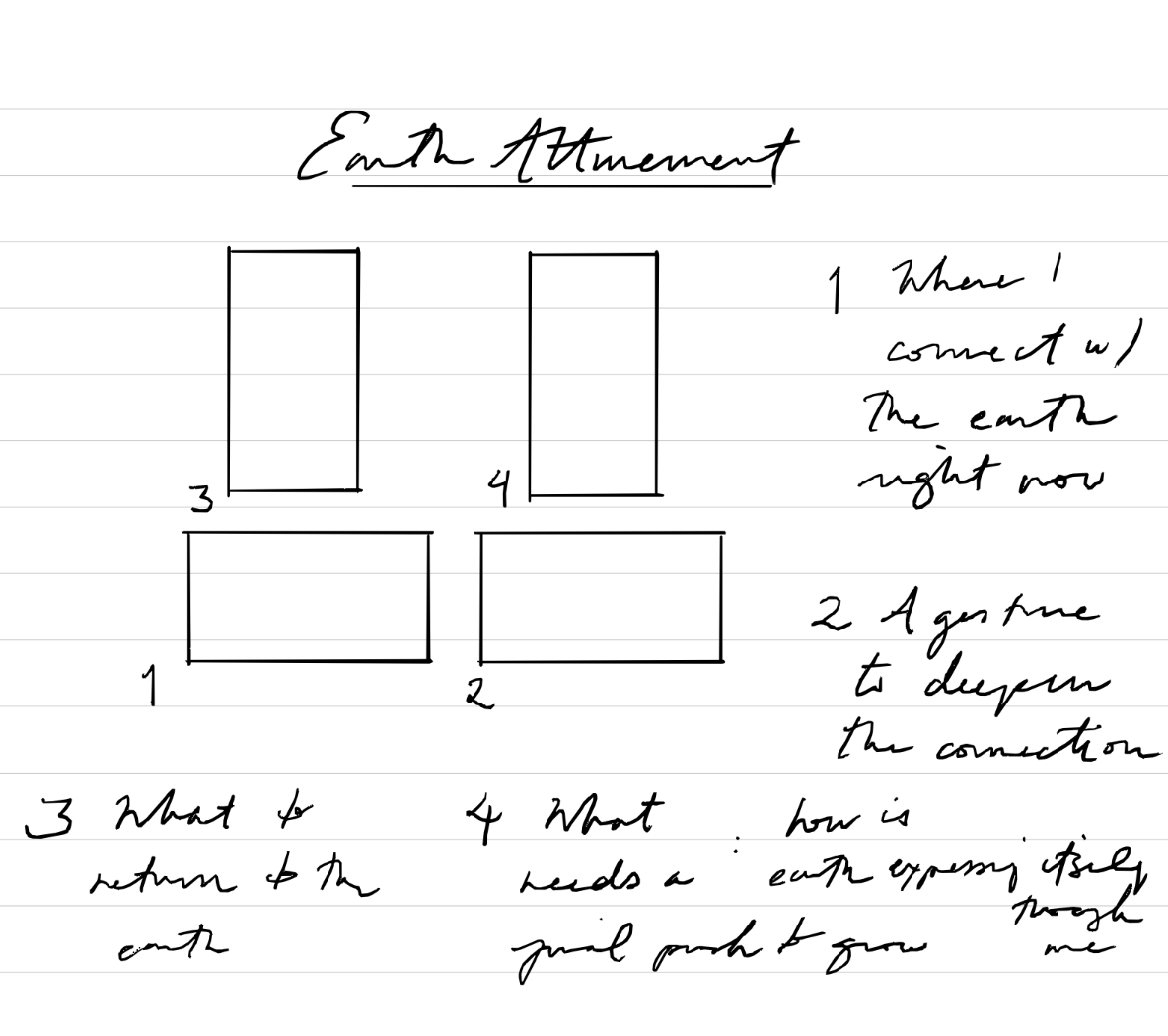
Earth Attunement

Expanding on the Earth-Body
Card One: Your personal cosmology + Card Two: Something to consider about your personal cosmology
Card Three: Your Ethics + Card Four: Something to consider about your personal ethics
Card Five: What your earth body needs for physical support + Card Six: something new your earth-body might need for support.
Earth-World Field Notes: A Seasonal Listening Journal
Using the same place at least two or three times would be especially useful. Repetition will reveal what a single recording cannot: shifts in bird and insect activity, wind, human movement, temperature, dryness or rain, and the changing sound of the same terrain.
Earth Field Notes hold the written observations and file name.
The Audio folder holds the actual recordings.
Use the same naming pattern in both, such as:
2026-07-20_Lair-Hill_Morning-Birds.wav
Enter quietly and allow the presence to soften into the living field. Begin recording once the earthling kin have resumed their rhythms.
Date and time
Location
Weather and sky
*Recording duration
Earthling kin present
Sounds heard while recording
What became audible on playback
How the field changed after arrival
File name
*Recording length guide
10–20 minutes for a weekly field recording
20–25 minutes when the place is especially active or changing
1–3 minutes for spontaneous daily fragments
Ursula K. Le Guin — Always Coming Home
Come among the unsown grasses, bearing richly the oaks, heavy with acorns, the sweet roots and unploughed earth. Come among the deer on the hill, the fish in the river, the quail in the meadows. You can take them. You can eat them. Like you, they are food. They are with you, not for you. Who are their owners? This is the puma's range. This hill is the vixen's. This is the owl's tree. This is the mouse's run. This is the minnow's pool. It is all one place. Come take your place. No fences here but sanctions. No war here but dying. There is dying here. Come hunt. It is yourself you hunt. Come gather yourself from the grass, the branch, the earth. Walk here, sleep well on the ground that is not yours but is yourself.
References and Influences
John Cage + Merce Cunningham
Chance Conversations: An Interview with Merce Cunningham and John Cage
https://www.youtube.com/watch?v=ZNGpjXZovgk
Laraaji
LARAAJI: Playing as the Field
https://www.youtube.com/watch?v=V8_llxcvT7U
Laraaji’s teachings also inform the use of laughter as an embodied energetic practice within the episode’s integration sequence.
Vickie Dodd / Sacred Soundworks
Teachings on sound, vibration, resonance and the body inform the use of humming within the integration practice.
https://sacredsoundworks.com/
David Abram + Merlin Sheldrake
On the Anarchic Proliferation of Earthly Perspectives
A deep-ecology dialogue between cultural ecologist David Abram and mycologist Merlin Sheldrake, originally published by Emergence Magazine, informs our inquiry into what it is to be Earthling and how we understand ourselves within the wider living world.
https://emergencemagazine.org/conversation/honoring-the-wild-proliferation-of-earthly-perspectives/
Hildegard Westerkamp
Field-recording and soundscape-composition practice, including ideas from Music, Sound and Conflict, informing the use of environmental recording as attentive encounter and compositional material.
https://www.youtube.com/watch?v=CnkzZAaaAlU
Annea Lockwood
Field-recording and environmental listening practices informing the approach to listening to, recording and composing with the Earth body.
https://pioneerworks.org/broadcast/sam-green-annea-lockwood
Evelyn Glennie
Touch the Sound
Recommended by Stuart Fowkes of Cities and Memory when we asked about documentaries that might support the composition of an Earth-body meditation using field recordings. The film’s exploration of listening through the whole body and of vibration beyond hearing alone informed our approach to resonance and embodied attention within the Earth-body sonic meditation.
https://www.youtube.com/watch?v=h61mwG9uQuUa
Freesound Sources
Soil Listening - Woodlice and Ants - 20 minutes - 06.05
by Mark_Taylor_Echophora_
https://freesound.org/s/734779/
License: Attribution 4.0
wind in willow 02 contact mic 150426_0644.flac
by klankbeeld
https://freesound.org/s/272322/
License: Attribution 4.0
Join In
If you feel called, use your preferred recording device to record your own earth listening practice, upload it to Freesound, and share the link in the comments so we can listen across places together. You may also explore Cities and Memory, where people around the world gather through shared acts of listening.
Practice Note — Breath + Movement
Please honor your body throughout the breath and movement practices. Nothing should feel forced, strained, dizzying, painful, or uncomfortable. If anything does not feel right, return to your natural breath, pause the movement, and rest as needed.
For alternate nostril breathing, keep the breath gentle and do not hold or force the breath. If you are congested, feeling lightheaded or short of breath, pregnant, or managing cardiovascular or respiratory concerns, you may choose to breathe naturally and simply listen instead.
Move only within a comfortable range, and choose stillness whenever that better supports your body.